LZ Caught One Event It Can't Explain. Is It Dark Matter?
TL;DR
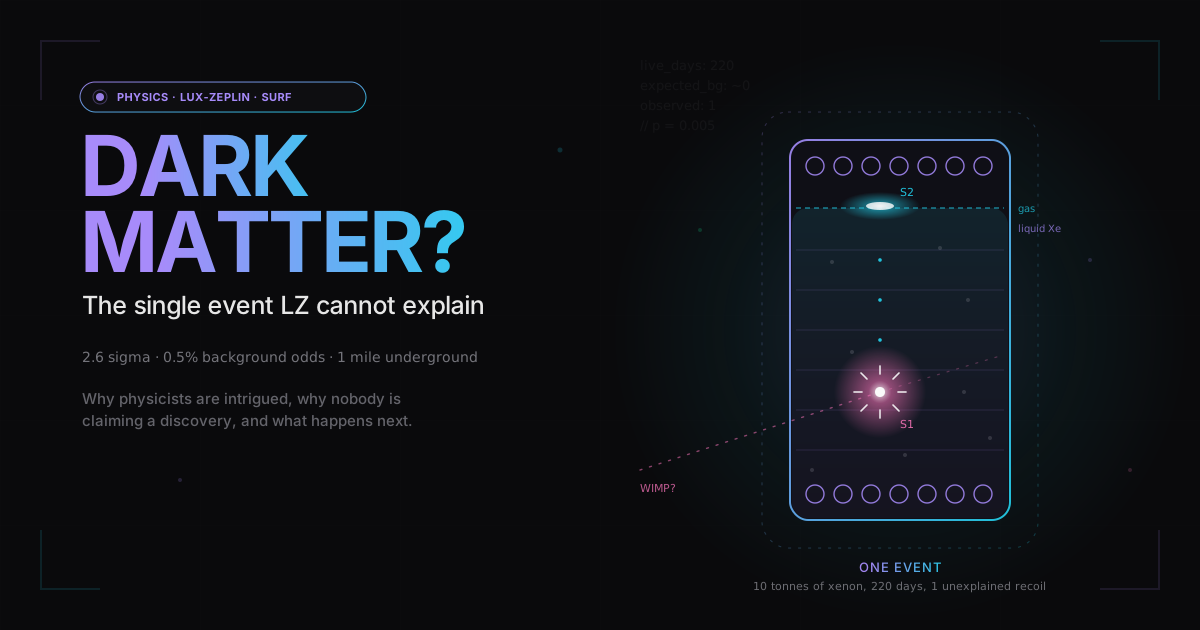
On 16 June 2023 the LUX-ZEPLIN (LZ) dark matter detector recorded a single nuclear recoil of about 248 keV in a region where its background model predicts roughly 0.01 events. Announced on 1 September 2026, the result has a global significance of 2.6 sigma, meaning roughly a 1-in-200 chance that background alone would produce something this extreme, far short of the 5-sigma discovery bar. If it is dark matter, the particle is heavier and interacts more strangely than the textbook WIMP. The collaboration is explicit that it is not claiming a discovery, and roughly three times more data already sits unanalysed.
At 21:22:39 UTC on 16 June 2023, deep inside a former gold mine in South Dakota, something hit a xenon nucleus hard enough to make it flinch with about 248 kiloelectronvolts of energy. Three years later, after months of background checks, the LUX-ZEPLIN (LZ) collaboration presented that single event to a conference in Japan on 1 September 2026. Its preprint reports that none of the rare backgrounds it studied could explain the event. Northwestern’s press release calls it “the most compelling hint of elusive dark matter to date.” The physicists involved are more careful, and the numbers explain why. This post walks through what LZ saw and how sure anyone can be. Then it looks at what would have to happen for one flash of light to become the first direct detection of the stuff that makes up 85% of the matter in the universe.
A note up front
Two disclosures. First, the research for this post was gathered by a Claude Code dynamic workflow: 55 subagents, mostly Haiku 4.5 and Sonnet 5, fetched the LZ preprint and conference slides, six institutional press releases, the LZ detector papers, ten news articles and the original papers behind every past dark matter “hint” mentioned below, then a critic agent listed what was missing and a second round filled the gaps. That took 584 tool calls and about 2.6 million tokens. A second workflow of 70 agents then fact-checked the draft: it split the text into 247 checkable claims, sent each to the source the post cites for it, escalated every doubt to a second checker, and flagged 20 claims, 18 of which led to corrections before publication. The model that read all of it and wrote these words is Claude Fable 5.1. Second, the primary source here is a collaboration preprint hosted on LZ’s own website. The collaboration says it will submit it to Physical Review Letters; as of writing it has not been peer reviewed and is not yet on arXiv. Where a number comes only from that preprint, the text says so.
The detector: an onion a mile underground
LZ lives on the 4,850-foot level of the Sanford Underground Research Facility (SURF) in Lead, South Dakota, in the Davis Cavern where Ray Davis ran his Nobel-winning solar neutrino experiment for nearly three decades. The site was the Homestake mine until 2001. Roughly 1.5 km of rock overhead blocks almost all cosmic rays, which is the whole point: a dark matter detector is a machine for hearing whispers, so you build it in the quietest place you can find.
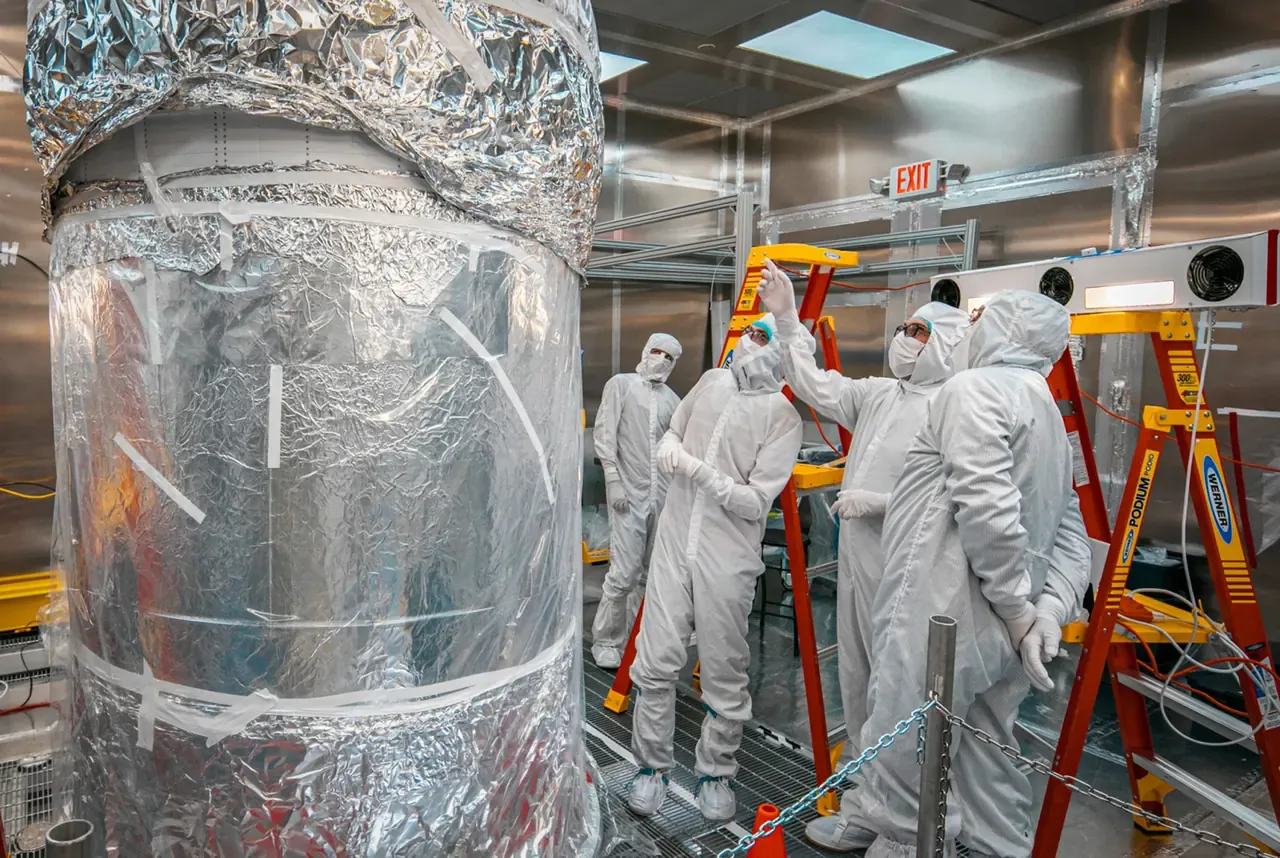
The LZ central detector in a surface cleanroom at SURF before it went underground. Image: Matthew Kapust/Sanford Underground Research Facility
The detector is built like an onion, from the LZ technical design paper outward:
| Layer | What it is | Job |
|---|---|---|
| Core | 7 tonnes of active liquid xenon in a cylinder 1.5 m wide and 1.5 m tall, watched by 494 photomultiplier tubes (253 on top, 241 below) | The target. Any particle that hits a xenon atom makes light here. |
| Skin | 2 tonnes of xenon around the core, separately instrumented | Catches gamma rays entering or leaving. |
| Outer detector | 17 tonnes of gadolinium-loaded liquid scintillator | Catches neutrons, the background most likely to fake a dark matter hit. |
| Water tank | 229 tonnes of ultra-pure water | Blocks radioactivity from the cavern walls and flags passing muons. |
In total the experiment holds 10 tonnes of xenon, a gas at room temperature that only liquefies below about −108 °C. About 250 scientists and engineers from 39 institutions in six countries run it, managed by the Department of Energy’s Lawrence Berkeley National Laboratory. It began taking science data in late 2021 and has repeatedly set world-leading limits on standard WIMP dark matter since, most recently in December 2025 with 417 live days of data.
How you see something invisible
The working hypothesis behind LZ is that dark matter is made of WIMPs, weakly interacting massive particles, streaming through the Earth constantly and almost never touching anything. Northwestern physicist Eric Dahl, an LZ co-author whose group tracks radon backgrounds in the detector, put it this way: “It’s like if you’re watching a table of pool balls. Then, an invisible cue ball collides into one of the balls. We can’t see the cue ball, but we know it’s there because the other balls start bouncing around. Something had to hit them.”
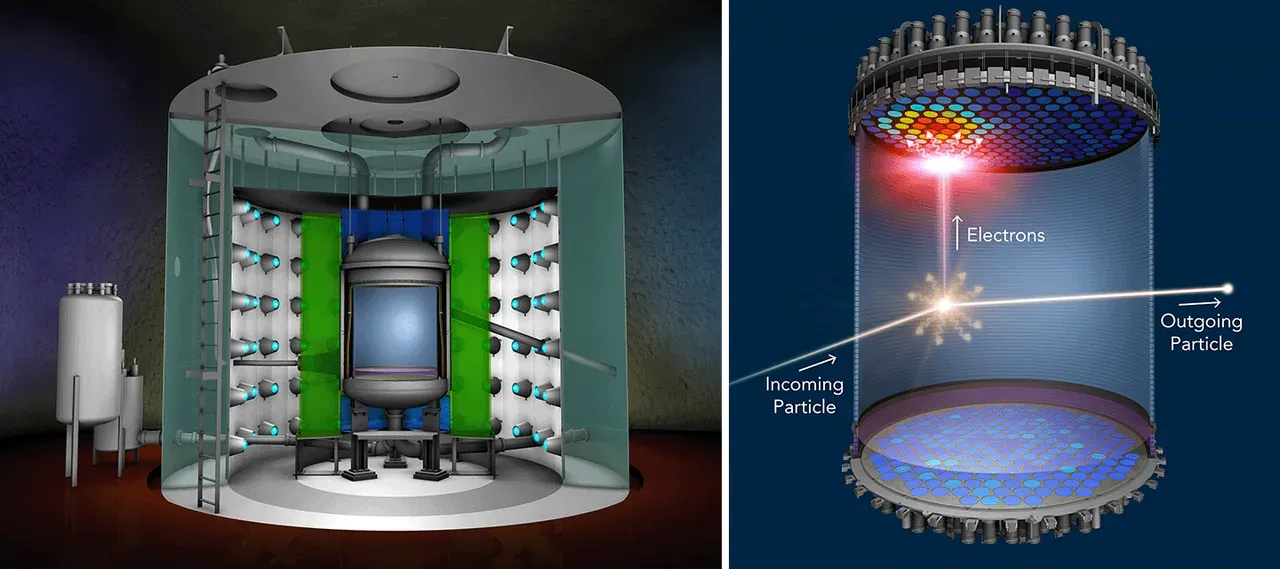
Left: the layered detector inside its water tank. Right: a recoil produces a prompt flash (S1), and an electric field drifts the freed electrons up into the gas layer where they make a second flash (S2). Image: Greg Stewart/SLAC National Accelerator Laboratory
When a xenon atom gets kicked, two things happen. Excited xenon atoms give off a brief flash of ultraviolet light, called S1. The impact also knocks electrons loose. An electric field, set up by electrodes with a cathode at the bottom of the chamber, pulls those electrons up through the liquid, a journey of up to about a millisecond. At the top they enter a thin layer of xenon gas, where a stronger field makes them emit a second, larger flash: S2. The delay between S1 and S2 gives the depth of the interaction. The pattern of S2 light on the top array of sensors gives its horizontal position. And the ratio of the two flashes says what kind of hit it was. An electron recoil from a gamma ray or beta decay produces relatively more S2. A nuclear recoil, which is what a WIMP would cause, produces relatively more S1. This ratio is the detector’s main lie detector, and at high energies it works very well.
What LZ saw
LZ’s headline WIMP searches look for recoils below about 55 keV, because that is where the simplest WIMP models put nearly all of their signal. The new analysis, led by Sam Eriksen of the University of Bristol, went back to the 220 live days of data taken between 27 March 2023 and 1 April 2024 and opened the window up to about 270 keV, something LZ had previously done only with its first 60 days of data. That is only interesting if you also change the theory. The new analysis tests a broader family of models in which dark matter does not hit nuclei in the simplest way. In some, the strength of the interaction depends on how hard the hit is (a momentum-dependent coupling). In others, the dark matter particle absorbs energy and jumps to a heavier internal state when it scatters (inelastic dark matter). Physicists call the toolkit for building these models non-relativistic effective field theory. All of them push a large fraction of the expected signal to high energies, exactly where nobody had looked in this dataset. The collaboration tested 616 such models, which reduce to 293 distinct recoil spectra.
The analysis used a fiducial volume of 4.71 tonnes, deliberately cut in from the walls, for a total exposure of 2.84 tonne-years. Exposure is a single number that combines how much xenon was watched with how long, so a bigger detector run briefly can match a smaller one run for years. Across the whole search region the background model predicted 1,713 ± 39 events, almost all of them ordinary electron recoils, and 1,710 were observed. Then, per the preprint, “one event in the science sample stands out in the NR band.” Eriksen put it plainly: “We understand our detector and the backgrounds so well that even a single outstanding event, like the one we found, is important.”
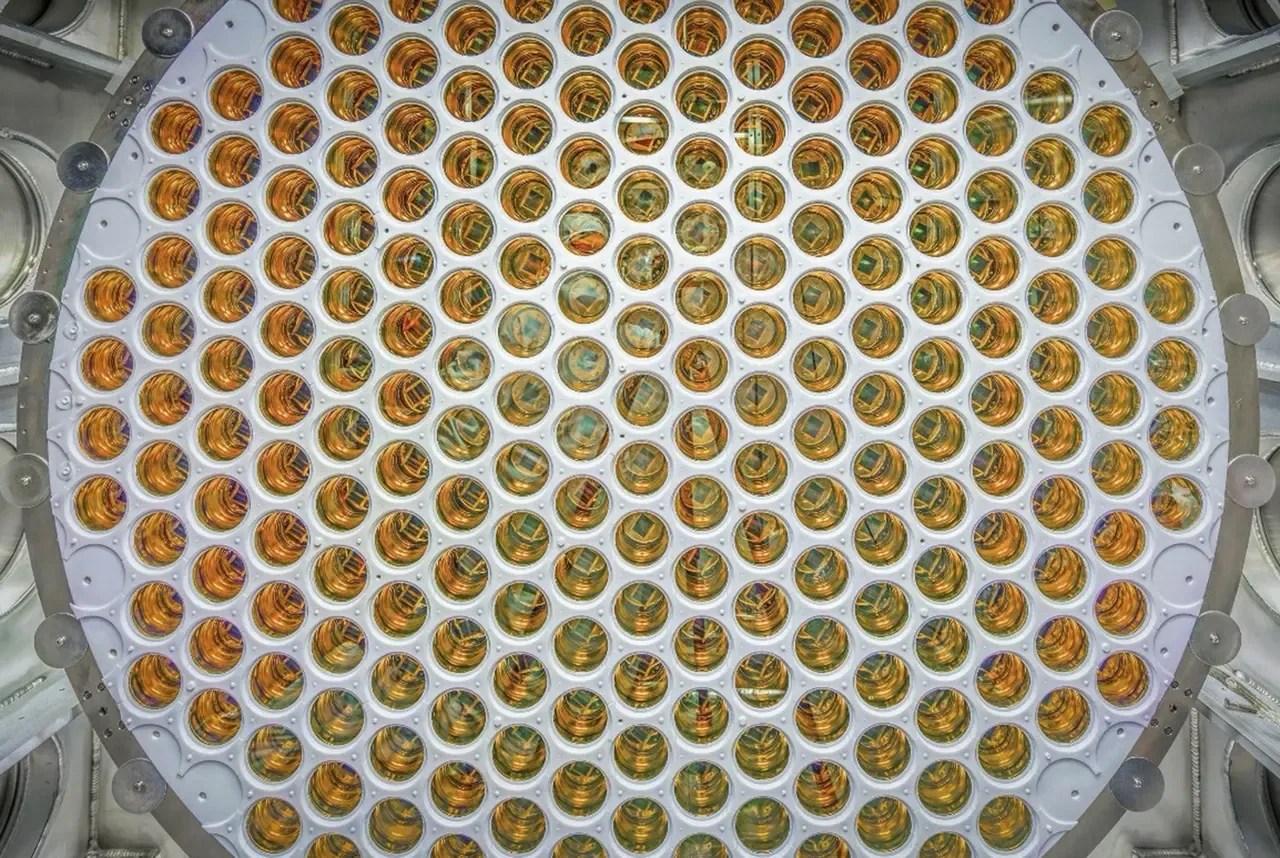
One of the two photomultiplier arrays that watch the xenon for flashes of light. Image: Matthew Kapust/Sanford Underground Research Facility
The vital statistics of that one event, all from the preprint:
| Property | Value |
|---|---|
| Time | 21:22:39 UTC, 16 June 2023 |
| Reconstructed recoil energy | 248 ± 23 (stat) ± 23 (sys) keV, treating it as a nuclear recoil |
| S1 / S2 light | 540.1 / 9,268 photons detected |
| Position | 26.4 cm above the cathode, 26.9 cm inside the true wall position |
| Distance from the electron-recoil band | 6.7 sigma below its median |
| Distance from the nuclear-recoil band | 1.5 sigma below its median |
| Expected background in its neighbourhood (S1 between 500 and 600 photons) | 0.0106 ± 0.0008 events |
That last line is the heart of the result. A region where you expect one hundredth of an event, and you find one. Aaron Manalaysay, a Berkeley Lab physicist who chairs LZ’s institutional board, said: “Outlier events in the data are not unexpected, but they usually stand out as a background of some kind when you look at them deeper. This is the first example in any experiment I’ve worked on of an outlier that appears valid in every way.”
What “0.5%” and “2.6 sigma” mean
The headline number is that there is roughly a 0.5% chance, about 1 in 200, that background alone would produce something at least this extreme. That is not the same as a 99.5% chance it is dark matter. Three things sit behind the number.
Local versus global significance. For a large subset of the models tested, the probability of the background alone producing something this extreme is below 1.3 × 10⁻³, about 1 in 770, a local significance above 3 sigma; the best-fitting model reaches 3.4 sigma. But LZ tested hundreds of models, and the more hypotheses you check, the more likely one of them lights up by chance. This is the look-elsewhere effect. After correcting for it with simulated fake datasets, the global significance drops to 2.6 sigma, which is where the 0.5% comes from.
The discovery bar is much higher. Particle physics conventionally demands 5 sigma, a chance of about 3 in 10 million, before using the word “discovery”. The threshold exists precisely because 3- and 4-sigma effects have a long history of vanishing. Three sigma is the usual bar for calling something “evidence”. LZ is not there either.
The analysis was not blind. This is the caveat that most coverage skipped. LZ normally protects itself from wishful thinking by “salting” its data with fake dark-matter-like events, so analysts finalise their selection cuts without knowing which events are real. The preprint says plainly that this “was unsuccessful” here: the fake events were generated from a model fixed before a neutron calibration and “did not adequately cover the signal region at high energies.” The cuts and likelihood models were still frozen before the salt was revealed, and the collaboration leaned on selection criteria unchanged from its earlier, blind analysis. But it concludes: “we consider the analysis described here to be a non-blind analysis.” That does not make the event less real. It does mean the usual guard against human pattern-seeking was weaker than LZ would have liked, and it is one reason the collaboration is so insistent on more data.
One event, 2.6 sigma, no blinding. Dahl’s own framing from the Northwestern release is the right one: “I don’t think anybody in the field would try to claim a discovery based on one event.”
Everything it probably isn’t
The interesting work in the paper is the year spent trying to kill the event. Dahl summarised the outcome: “After doing the math, we haven’t found anything with even a 1% chance of creating something like this signal.” The preprint and Eriksen’s conference slides go through the suspects one by one:
- A neutron. The classic WIMP impostor, because a neutron also bounces off nuclei. But a neutron needs at least 8 MeV to give a xenon nucleus 250 keV, and at those energies it scatters mostly forward, depositing little. A neutron population energetic enough to do this would have produced several lower-energy hits first. None appeared. The veto layers, the xenon skin and the outer detector together, tag 92 ± 4% of neutrons from detector materials, and a simulation of 1,200 years of LZ exposure to muon-induced neutrons produced nothing in the signal region. The last muon seen anywhere in the detector was 41 minutes earlier.
- A neutrino. Atmospheric neutrinos can nudge nuclei, but the process is strongly suppressed at large momentum transfer, and, as with neutrons, you would expect a pile of gentle recoils before a violent one. The whole-search expectation was about 0.1 events, nearly all at low energy.
- An accidental coincidence. Two unrelated flashes, an orphan S1 and an orphan S2, lining up in time to fake one interaction. The model predicts 2.7 ± 0.6 such events across the entire search region, but they cluster at low energy, and the event sits in a low-probability corner of that distribution.
- A multiple scatter with lost charge. A gamma ray that deposits energy twice, once in a spot where the electrons are never collected, can mimic a nuclear recoil. Expected count in the science sample: 0.005 ± 0.005. For this event, the preprint estimates, the gamma would have had to travel more than 60 cm through xenon without interacting, then scatter once more without producing S2, and evade both veto layers. The collaboration validated its model of these events in a higher-energy sideband and a larger volume and found no inconsistency.
- Radon. The leading everyday background is beta decay of radon daughters in the xenon. It dominates the electron-recoil band, which is why the event’s position 6.7 sigma below that band matters. LZ’s radon-tagging technique, which predicts where decaying radon daughters drift, could not be applied because the xenon happened to be in a well-mixed circulation state at the time.
- The calibration source. A cobalt-57 source had been removed from the detector 25 minutes before the event, but on the opposite side, and its gamma rays travel less than 4 mm in xenon. No anomalous populations were found in the surrounding data.
The paper does flag one soft spot itself. Interpreted as an electron recoil, the event’s energy lands close to two rare double-vacancy decays (a process that ejects two inner-shell electrons at once) of xenon-124 and iodine-125 at 64 and 67 keV, which produce unusually little S2. The collaboration models them but notes a systematic uncertainty in how far their tails extend that it does not fold into the statistical result. Its counterargument is that there is a conspicuous absence of events between the outlier and the bottom of the electron-recoil band.
If it is dark matter, it is a strange kind
Here the story turns from a detector puzzle into a physics one. The textbook WIMP, scattering elastically off a nucleus with no momentum dependence, would mostly produce recoils of a few keV to a few tens of keV. Dahl’s comparison is that a normal hit would carry “about as much energy as a single X-ray photon”, while this one carried much more. In the simplest models, as Scientific American noted, dozens or hundreds of gentler events should have shown up before one like this. They did not.
So the event only makes sense under models that starve the low-energy end of the spectrum. Two examples from the preprint: a magnetic-dipole coupling, which gives a broad, double-peaked recoil spectrum, and inelastic scattering, where the dark matter particle absorbs energy to jump to a heavier state, so only the hardest collisions register. The latter, as the paper says, “resembles a Higgsino model”, a favoured candidate from supersymmetry, the theory that pairs every known particle with a heavier, undiscovered partner (the Higgsino being the partner of the Higgs boson). Under any of them the particle would be heavy: typically at least 200 times the proton mass, and, per Nature’s coverage, probably around 1,000 GeV. Theorists moved fast. Within a day of the announcement at least four interpretation papers appeared on arXiv, proposing inelastic dark matter, a TeV-scale Higgsino (twice, independently), and fermionic dark matter absorption.
There is one more curiosity. Inelastic models predict an annual modulation peaking around 2 June, when the Earth’s orbital motion adds most to its speed through the galactic dark matter halo. The event was recorded on 16 June. NYU theorist Neal Weiner told Science News the timing was “particularly notable.” It is also exactly the sort of after-the-fact coincidence that a single event cannot distinguish from luck.
We have been here before
Dark matter has a long memory of hints that faded, and the LZ authors know it. Dahl again: “When this field was getting started, we frequently found that we hadn’t thought of everything a detector could do to trick us. Our understanding of these detectors is much, much better now, but it’s still possible that we’ve found something that only looks like dark matter — something that we weren’t creative enough to think of ahead of time.” A short list:
| Experiment | Year | Claim | Outcome |
|---|---|---|---|
| DAMA/LIBRA | 1998 onward | Annual modulation in sodium-iodide crystals, claimed at above 10 sigma | Never reproduced. COSINE-100 and ANAIS-112, using the same crystal type, exclude the dark matter interpretation. |
| CoGeNT | 2011 | 2.8-sigma annual modulation in germanium | Faded; part of the excess traced to an unrecognised surface background. |
| CDMS-II silicon | 2013 | Three candidate events against 0.41 expected, about 3 sigma | Never confirmed and excluded by later, more sensitive experiments. |
| XENON1T | 2020 | Excess of low-energy electron recoils, with a solar-axion interpretation favoured at 3.4 sigma | Its successor XENONnT saw nothing in 2022; the excess is attributed to trace tritium in the xenon. |
The XENON1T episode is the closest parallel: a xenon detector, a background nobody had fully modelled, a significance above 3 sigma, and a resolution two years later when a cleaner detector looked again. What is different this time is the location of the anomaly. The XENON1T excess sat in the crowded electron-recoil band at the lowest energies; the LZ event sits alone in a nuclear-recoil region where the model predicts a hundredth of an event. That is why the reactions from outside the collaboration have been warmer than usual, if still hedged. UC Berkeley theorist Wick Haxton told Science News it is “the most interesting thing that’s come up in recent times.” Dan Hooper of the University of Wisconsin–Madison gave the counterweight in the same piece: “It’s only one event. So who knows what’s really going on here.” He added: “That said, it’s intriguing.” Jayden Newstead of the University of Melbourne told ABC News, “It’s not how we would expect dark matter to have appeared,” and added that whenever experimentalists are confused, “it’s always exciting for theorists.”
What happens next
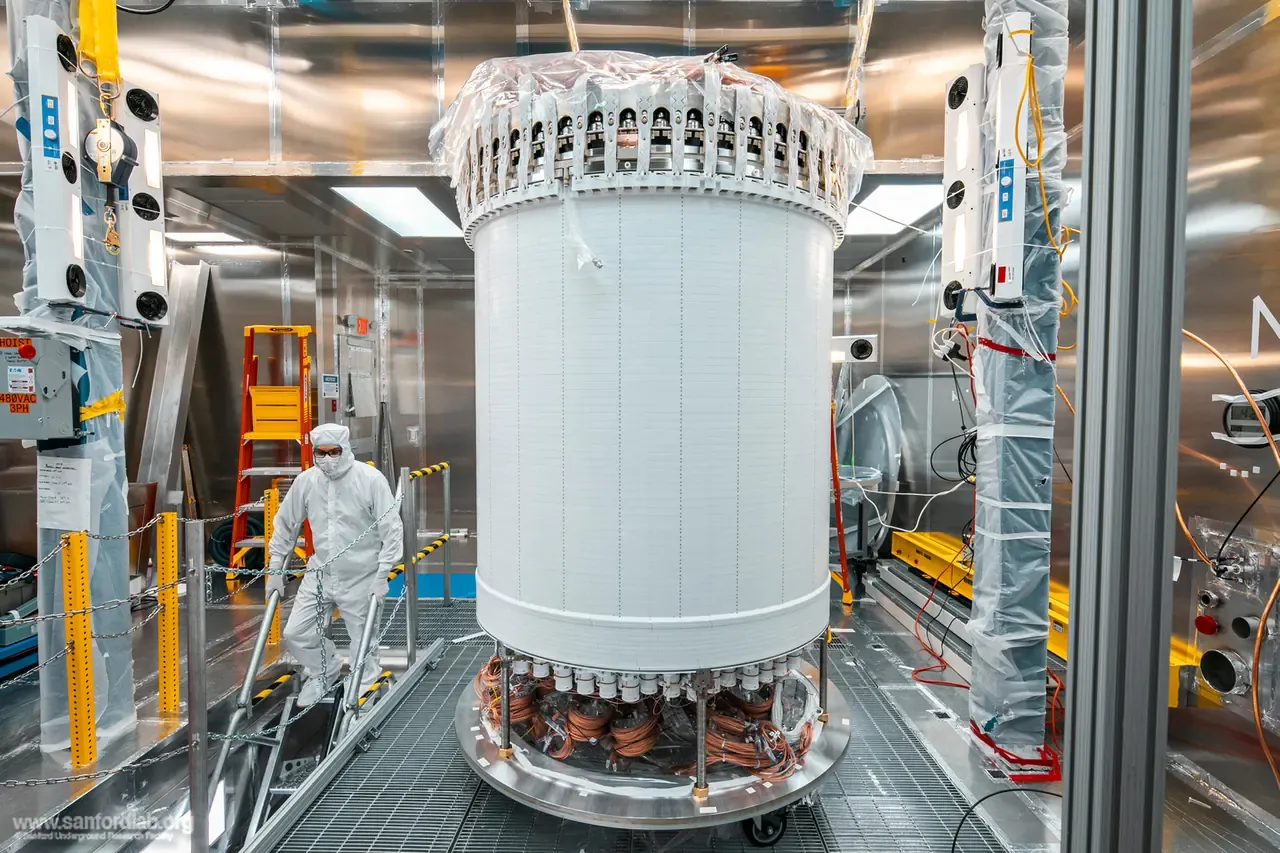
The LZ time projection chamber before installation. It has been recording data in the same configuration since April 2024. Image: Matthew Kapust/Sanford Underground Research Facility
This is where a one-event result becomes a testable one, and the timeline is short by physics standards.
- More LZ data, already in hand. The 220 days analysed here are about a quarter of what LZ will collect. The detector has run in the same electric-field configuration since April 2024, and co-spokesperson Rick Gaitskell told Scientific American the collaboration has “over 700 days blinded.” If the event is a heavy dark matter particle, a rate of one per 2.84 tonne-years implies a handful more in the data already recorded. Zero more would be a bad sign. The run continues toward 1,000 live days by 2028, and the collaboration is exploring an extension.
- Cross-checks by rivals. XENONnT in Italy and PandaX-4T in China are xenon detectors of the same type with smaller xenon targets. According to Nature, earlier XENON and PandaX searches in this energy range found nothing beyond the expected background, and both experiments, as ABC News noted, could help check the result. Jianglai Liu of Shanghai Jiao Tong University, a PandaX physicist, told Nature the result “is intriguing, and will undoubtedly excite the field.”
- A bigger detector. The planned XLZD observatory, a merger of the LZ, XENON and DARWIN efforts, would hold 60 to 80 tonnes of xenon, roughly ten times LZ’s active mass, and by Imperial’s estimate could run by the mid-2030s. Imperial’s Henrique Araújo, XLZD’s co-spokesperson, offered the sober version of the outlook: “We shouldn’t be too surprised that rare event searches are also sensitive to rare backgrounds, so we need to analyse more data to be sure.”
No date has been given for the next update on this specific event. The closest thing to a forecast is Chamkaur Ghag’s, LZ’s UCL-based co-spokesperson, in BBC Sky at Night: “Whether this event turns out to be dark matter or an extraordinarily unlucky background, the coming years of data will tell us, and either way it’s a strong test of everything the collaboration has built.”
Should you care?
Yes, but for the right reason. Not because dark matter has been found, which it has not, and the people who built the detector are the first to say so. Theresa Fruth of the University of Sydney, an LZ member, told ABC: “This event just won’t go away even after many, many checks. It’s also kind of scary to think, ‘Oh, this could be it.’”
The reason to care is that this is what a real detection would look like at the very beginning: a single, well-measured event in a region a mature experiment understands to the hundredth of a count, surviving a year of attempts to explain it away, in a dataset with a known path to confirmation or refutation. Most hints fail that last test. LZ has told us exactly how it will be judged, by the several hundred days of data it already has. Dahl has spent 20 years in this field and calls this “the most interesting single event that I’ve seen.” The honest translation is not “we found it.” It is “we finally have something worth waiting for.”
Sources
- Northwestern Now: Dark matter detector picks up a mysterious signal (Eric Dahl quotes)
- Berkeley Lab: LZ sees surprising result in search for dark matter (Eriksen and Manalaysay quotes; 220 live days; 2.6 sigma)
- LZ Collaboration preprint: Search for dark matter particle interactions in an extended nuclear recoil energy window with the LUX-ZEPLIN (LZ) experiment (D.S. Akerib et al., to be submitted to Physical Review Letters; event details, background table, salting, significance)
- Sam Eriksen’s TeVPA 2026 slides and the TeVPA 2026 contribution page
- The LUX-ZEPLIN (LZ) experiment (technical design paper) and the LZ detector page
- Dark matter search results from 4.2 tonne-years of exposure of the LUX-ZEPLIN experiment (the 2024 result and the WS2024 dataset) and LZ’s first extended-window EFT search
- Berkeley Lab: LZ sets a world’s best in the hunt for galactic dark matter (December 2025, 417 live days, 1,000 days by 2028)
- SURF: LUX-ZEPLIN (site, depth, Homestake and Davis history)
- Brown University, Imperial College London, Lawrence Livermore and University at Albany releases
- Scientific American: Have we finally found dark matter?
- Science News: Dark matter hunters may have finally spotted a hint of the particles
- Nature: Is this the first glimpse of dark matter? Data point excites physicists
- ABC News Australia: ‘Exciting hint’ of dark matter spotted by LUX-ZEPLIN detector
- BBC Sky at Night Magazine: Have we finally found dark matter?
- CERN Courier: Five sigma revisited
- Past hints: CDMS-II silicon results, XENON1T electronic recoil excess, XENONnT first results, CoGeNT modulation, COSINE-100 test of DAMA/LIBRA
- Theory responses: arXiv:2609.01475, arXiv:2609.01583, arXiv:2609.01590, arXiv:2609.01592
- XLZD (next-generation xenon observatory)