Omarchy Quattro: the Linux distro that agents build and test
TL;DR
Omarchy 4.0 “Quattro” shipped on 14 August 2026 with a Quickshell desktop shell, pacman packaging and a configurable default coding agent that also diagnoses crashes. DHH says it was built almost entirely by agents, and ThePrimeagen now leads agentic QA with a QEMU-based harness. The Omacom Foundation behind it lists about $23.5 million in pledges, part of it in model tokens, and becomes Hyprland's exclusive sponsor on 10 October 2026.
Omarchy, DHH’s opinionated Arch Linux and Hyprland desktop, shipped its 4.0 “Quattro” release on 14 August, and the release notes read less like a distro changelog than a spec for an agent-first computer. Two months on, the Omacom Foundation behind it lists roughly $23.5 million in pledges, part of it paid in model tokens, and from today it is Hyprland’s exclusive sponsor. Here is what changed, and why I think it matters beyond Linux.
It stopped being a pile of dotfiles
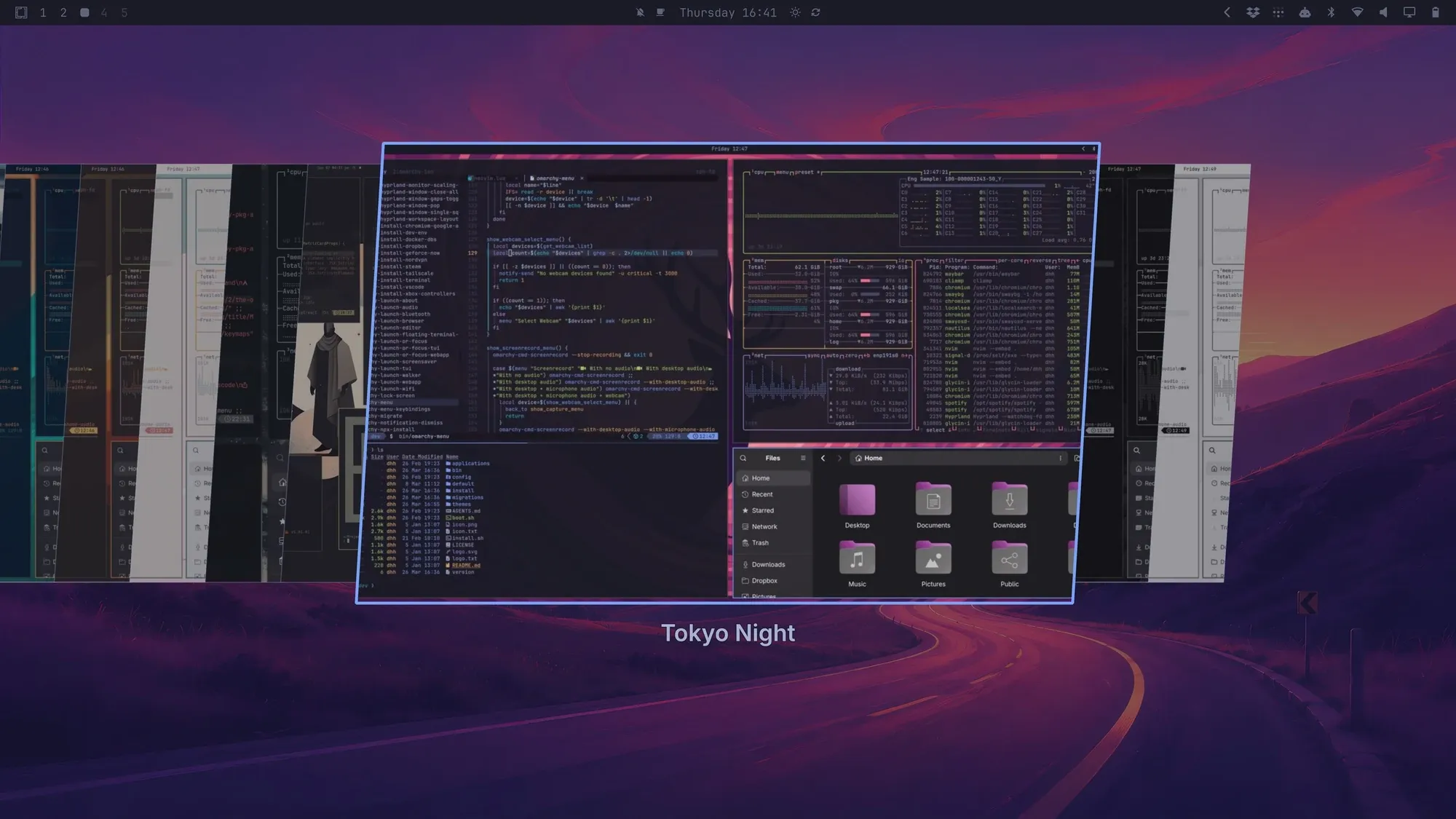
Omarchy started life as a set of config files on top of Arch, and DHH concedes the early detractors weren’t entirely wrong about that. Quattro is where it turns into a real distribution. The release moves Omarchy’s internals into proper Arch packages, so updates flow through pacman and your own modifications stay separate from the system’s. The whole desktop shell, from the bar and launcher to notifications, the lock screen and the polkit agent, now runs as one Quickshell process with a plugin architecture, replacing Waybar, Walker, Mako, SwayOSD, hyprlock, hypridle, swaybg and polkit-gnome.
The rest of the list is the kind of work that makes a distro installable by people who aren’t you: an ISO under 6 GB, installs about 30% faster, dual boot when there is free space, setting up a machine for a new owner, and a factory reset that rolls back to a snapshot taken at install time. The Hyprland config is now Lua. None of that is glamorous, but the packaging change is the one I’d point to if someone asks whether Omarchy is still a hobby project. It isn’t.
The coding agent is a system default now
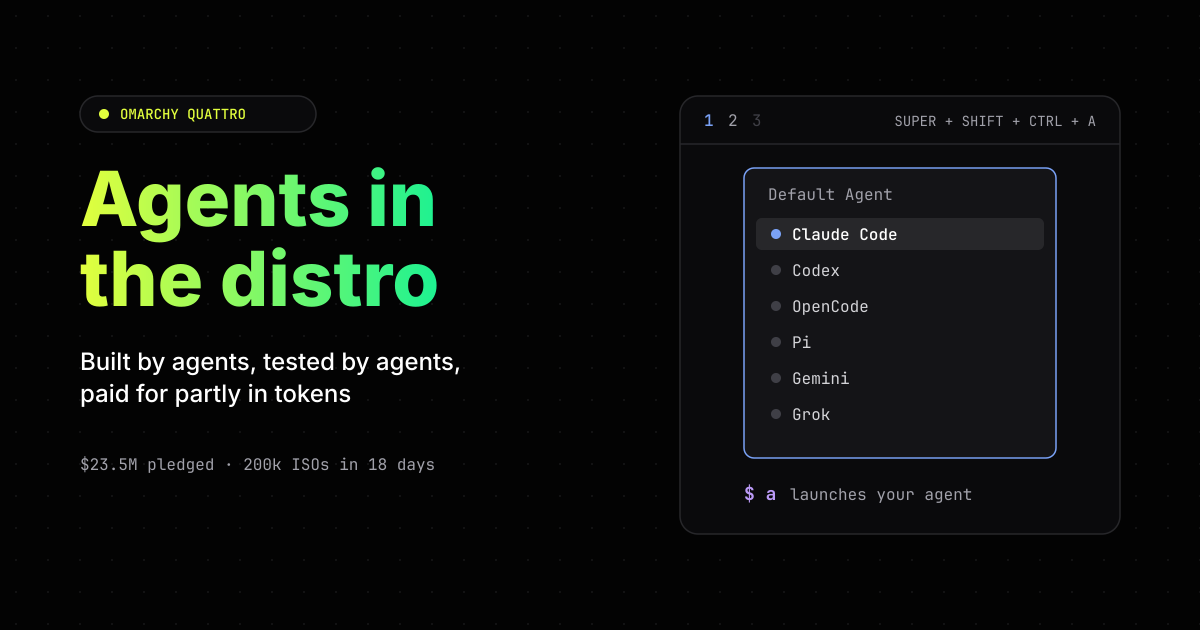
This is the part that makes Omarchy interesting for anyone who builds with agents. Under Setup > Defaults > Agent you pick Claude Code, Codex, OpenCode, Pi, Oh My Pi, Gemini, Grok, Copilot or Crush. It installs lazily on first use through mise, opens as its own app, and starts in ~/Work when you summon it from home, so trust settings actually stick.
# Pick once under Setup > Defaults > Agent, then from any terminal:
a
# or press Super + Shift + Ctrl + A anywhere on the desktop
Around that sit smaller touches: a bar widget that shows your Claude Code and Codex usage, and the active Omarchy theme synced into Claude Code. The one that stands out is crash handling. When a process crashes, systemd-coredump raises a toast; click it and your default agent gets briefed on the core dump with a diagnose-crash skill that symbolizes the backtrace and, only with your agreement and after searching for duplicates, reports a confirmed Omarchy bug upstream.
The crash-diagnosis loop is the feature I’d steal. The OS notices that something broke, hands the agent the context it needs, and keeps a human in the loop before anything leaves the machine. That is the right shape for agents on a desktop, and I haven’t seen another distro ship it as a default.
It is built and tested by agents too
DHH writes that Quattro was built almost entirely by agents, because they are good at exactly what a distro is made of: bash, QML and debugging Linux issues. The same post mentions a backlog of more than 1,600 pull requests a few weeks after launch. On 10 October the repository showed about 35,500 stars and roughly 1,300 open pull requests.
That backlog is the honest number in this story. Agents and enthusiastic users produce contributions faster than any core team can review them, so Omarchy is pointing agents at the other end of the pipe as well. ThePrimeagen joined Omarchy Core on 26 September to lead Agentic QA with Oligarchy, a harness that boots Omarchy in QEMU virtual machines and lets agents drive it like a person: keystrokes, mouse clicks, screenshots, and a verdict on whether things did what they should. Each test is a ticket that boots from a fresh disk, and a fleet of clients works through them. Every team shipping agent-written code is going to hit this loop, where generation is cheap and verification is the bottleneck. Omarchy is just hitting it in public.
Tokens became a way to fund open source
The Omacom Foundation launched on 21 August as a nonprofit to hold the trademarks, pay for infrastructure and back the projects Omarchy depends on. Its launch post is updated as patrons join and now totals about $23.5 million. Twelve individuals pledge $1 million each, and corporate patrons choose between cash over three years and a one-off pledge in tokens. Meta Superintelligence Labs pledged $1.5 million in tokens, SpaceXAI added $1.5 million in Grok tokens on 8 October, and OpenAI, Fireworks, OpenRouter and OrcaRouter pledged $150,000 each. Namespace joined on 9 October with $100,000 a year in compute for ARM builds and QA.
The money is already moving. The foundation has hired full-time heads of the kernel, the shell (outfoxxed, who created Quickshell) and infrastructure, sponsors mise, and from today funds Hyprland’s creator Vaxry under a three-year deal with an option for two more, which also lets the paid Hyprperks program go free for everyone. It also opened a $100,000 bug bounty on HackerOne on 2 October.
I’d read the headline number with care. Token pledges are counted at their stated dollar value, which is a lab’s list price rather than its cost, and tokens are only worth something if the project can turn them into correct, merged code. An OpenReplay analysis also notes that no official page describes a board, a governance structure or a jurisdiction of incorporation. Still, this is the first donation tier I’ve seen denominated in inference, and for a project that ships mostly agent-written code it is the most direct form of support there is. I expect other open-source projects to copy it.
Who should install it
If you live in a terminal, want a keyboard-driven tiling desktop that is ready for agents out of the box, and are comfortable on Arch, Quattro is worth a weekend. Install from the ISO, and take a backup first, as the release notes say. Expect strong opinions: Omarchy is DHH’s taste, defaults change quickly, and the agent features assume you already pay for at least one model. The project has also announced teams for Apple hardware and Snapdragon, so Mac and ARM laptop owners should watch those before switching.
Even if you never run it, Omarchy is a useful preview. It treats the coding agent as part of the operating system, uses agents to build and test that system, and pays for it partly in tokens. Each of those ideas will show up elsewhere soon.